
Can Red Light Therapy Age Your Skin? Debunking Myths and Revealing the Truth
Two questions, one evidence-based answer: no, red light therapy does not age your skin — and yes, the evidence supports it as an anti-aging tool. Red and near-infrared light are non-ionizing; they stimulate cellular repair rather than damage it. Controlled trials show measurable collagen-density increases over roughly 10–12 weeks of consistent use, alongside texture and firmness improvements. The genuine cautions are about overuse (temporary redness, not accelerated aging), device quality, and realistic expectations — not about the light itself. This guide answers both questions with the evidence, grades common concerns, and links to our deep-dive myth-busting guide for the full physics.
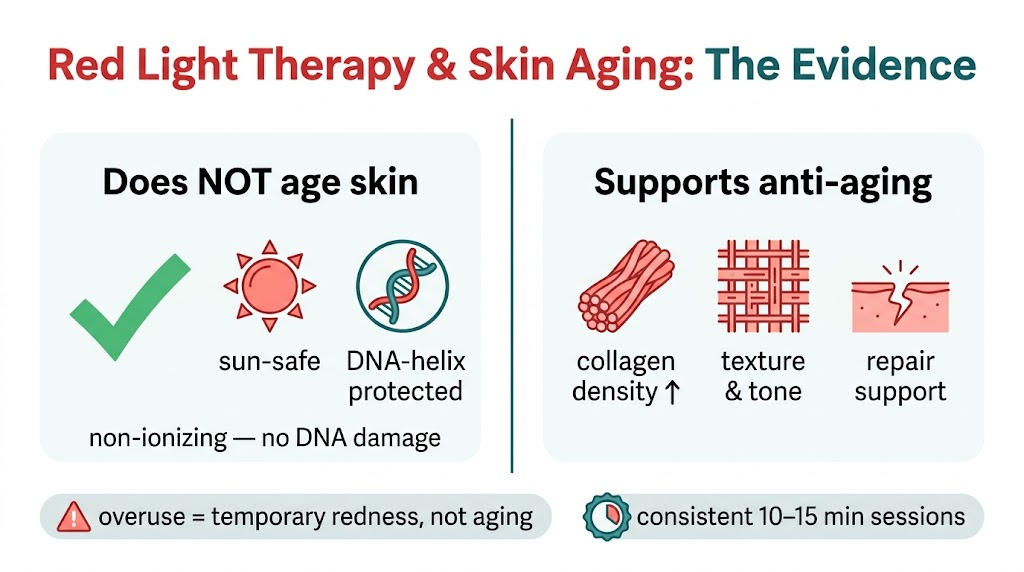
Table of Contents
- 1. RLT and Its Role in Skincare
- 2. What Red Light Therapy Actually Does
- 3. Can RLT Age Your Skin? The Evidence
- 4. What Dermatology Literature Says
- 5. Anti-Aging Benefits, Graded by Evidence
- 6. How to Use RLT Safely and Effectively
- 7. Addressing Common Concerns
- 8. Conclusion: Youthful, Healthy Skin
- 9. Partner With Rainbow Technology
- 10. References
1. Introduction: Understanding Red Light Therapy and Its Role in Skincare
Red light therapy (RLT), also known as photobiomodulation, has gained widespread popularity as a non-invasive, science-backed skincare treatment. It is used to rejuvenate the skin, reduce fine lines, improve elasticity, and support overall skin health.
Despite its growing use, some people worry: “Can red light therapy actually age my skin?” — a fair question, because light and skin aging are usually discussed together in the context of UV damage.
This article examines the science and safety guidelines to answer both halves of that question — does RLT accelerate aging (no), and is it genuinely anti-aging (yes, with evidence) — with actionable advice for your skincare routine. For the full myth-busting deep dive on the physics, see our companion investigation: Can Red Light Therapy Age Your Skin?
2. What Is Red Light Therapy and What Does It Actually Do?
Red light therapy uses specific wavelengths of red and near-infrared light — the clinically referenced device bands are red 630–660 nm and near-infrared 810–850 nm — to penetrate the skin safely. Unlike UV rays or aggressive laser treatments, red light stimulates cellular processes without causing damage: it is non-ionizing, and its photon energies sit far below the threshold associated with DNA damage.
Key mechanisms include:
- Photobiomodulation: Enhances ATP (cellular energy) production in mitochondria[1]
- Collagen & elastin production: Stimulates fibroblasts, promoting skin firmness and elasticity[2]
- Improved blood flow: Increases microcirculation, delivering nutrients and oxygen to cells
- Inflammation reduction: Downregulates pro-inflammatory signaling, reducing redness and irritation[1]
These processes support skin repair, rejuvenation, and natural anti-aging — the opposite of a mechanism that would accelerate aging.
3. Can Red Light Therapy Age Your Skin? The Evidence
Based on current research and dermatology literature, red light therapy does not accelerate skin aging. In fact, studies suggest it may have protective and rejuvenating effects:
- Collagen boost: A controlled trial of 136 participants found significant increases in intradermal collagen density after roughly 30 sessions over 12 weeks, with reductions in fine lines, wrinkles, and roughness[2]. Supporting cell-level data shows pulsed 660 nm light increasing type I procollagen by 31% while reducing MMP-1 (a collagen-degrading enzyme) by 18%[3].
- Skin texture & tone: Regular use can smooth uneven texture and soften fine lines. Pigment-lightening claims remain an emerging area — RLT is not a first-line lightening treatment.
- Wound healing & scar support: RLT promotes tissue repair, and LED therapy has documented dermatology applications in recovery contexts[4].
Overuse Concerns — Real, but Not “Aging”
While generally safe, excessive sessions may cause temporary redness, dryness, or mild irritation. Red light follows a biphasic dose response — beyond the effective window, more exposure doesn’t add benefit[5]. But there is no evidence that overuse leads to premature aging. Most professional devices recommend 3–5 sessions per week, 10–15 minutes each — see the dose science in How Long Should Red Light Therapy Sessions Be?
4. What Dermatology Literature Says
Board-certified dermatologists commonly describe RLT in patient education as safe, non-invasive, and useful as a supportive modality: it enhances cellular energy without thermal injury, reduces inflammation, and supports collagen and fibroblast activity. We present this as the consensus visible in peer-reviewed literature rather than as individual endorsements, so every claim stays traceable:
- A systematic review of LED randomized controlled trials authored by dermatology researchers supports clinical use for several indications — including recovery after procedures — while noting the field’s limitations (small samples, parameter variability)[4]
- Controlled-trial data show measurable anti-aging outcomes (collagen density, fine lines) over consistent 10–12 week protocols[2]
- Mechanistic research supports anti-inflammatory effects relevant to skin health and recovery[1]
These perspectives reinforce that RLT supports skin health rather than accelerating aging.
5. Anti-Aging Benefits, Graded by Evidence
| Benefit | Evidence Grade | What the Data Shows |
|---|---|---|
| Collagen & firmness | ✅ Good | Significant collagen density increase in controlled trials[2][3] |
| Fine lines & wrinkles | ✅ Good | Reduced fine lines and roughness over 10–12 weeks[2] |
| Texture & tone | ✅ Good | Smooths rough patches; redness reduction via anti-inflammatory effect[1] |
| Wound healing & recovery | ✅ Good | LED therapy supports recovery contexts in dermatology use[4] |
| Pigmentation / dark spots | ⚠️ Emerging | Not a first-line lightening treatment; evidence still limited |
6. How to Use Red Light Therapy Safely and Effectively
To maximize benefits while protecting your skin:
- Follow recommended frequency: 3–5 sessions per week, 10–15 minutes each[5]
- Choose quality devices: Look for FDA-registered devices with documented wavelength and irradiance specs — verified output is the difference between a skincare tool and an expensive light show. See the LED Mask Buyer’s Guide and how to verify FDA clearance.
- Protect sensitive areas: Use goggles if light-sensitive; avoid prolonged direct eye exposure — Do You Need Goggles?
- Combine with skincare: Apply hydrating or antioxidant-rich serums post-treatment on clean, bare skin — moisturizing after RLT
- Consult your dermatologist: Especially if you have photosensitive conditions or take medications that increase light sensitivity — who should be careful
7. Addressing Common Concerns
| Concern | Evidence-Based Answer |
|---|---|
| Can RLT age skin? | No credible evidence supports premature aging from RLT — red/NIR are non-ionizing and don’t damage DNA |
| Can RLT damage skin? | Unlike UV, RLT does not burn or peel skin when used properly; mild temporary redness is the main reported effect |
| Side effects of overuse | Temporary redness or dryness may occur; biphasic dose response means more isn’t better[5] |
| Device quality | Low-quality devices may deliver ineffective or unsafe light doses — verify wavelength specs and FDA documentation |
| Retinol + RLT = photosensitivity? | No — retinol photosensitivity is UV-specific, and LED devices emit no UV. Sequencing matters, not phototoxicity — retinol after LED |
| If I stop, will skin age faster (“rebound”)? | No rebound effect — collagen gains fade gradually as normal aging resumes; consistency is what maintains results |
8. Conclusion: Red Light Therapy Supports Youthful, Healthy Skin
Red light therapy is not only safe but also potentially rejuvenating. When used consistently with quality devices and proper guidance, it can boost collagen and elastin, smooth skin texture and tone, reduce inflammation and support scar recovery, and support overall skin health.
Bottom line: red light therapy does not age your skin — it complements your skincare routine when used responsibly.
9. Partner With Rainbow Technology
“Does it age skin or not” is settled by physics; “does it actually work” is settled by engineering. The anti-aging evidence in this article comes from devices that can hold a wavelength — and that’s a manufacturing question:
- Verified wavelengths: 630–660 nm red / 810–850 nm NIR — spectrometer-verified per batch, irradiance stated at working distance.
- Documentation: FDA registration & 510(k) documentation available for partner review; CE, RoHS, FCC, KC; IEC 62471; ISO 13485 + MDSAP QMS.
- OEM/ODM: Custom wavelengths, molds, private labeling, firmware — from concept to certified product. Consult our engineering team; see designs on our product lineup.
Request your custom quote today.
10. References
[1] Hamblin MR.
Mechanisms and applications of the anti-inflammatory effects of photobiomodulation. AIMS Biophysics. 2017;4(3):337-361.
[2] Wunsch A, Matuschka K.
A controlled trial to determine the efficacy of red and near-infrared light treatment in patient satisfaction, reduction of fine lines, wrinkles, skin roughness, and intradermal collagen density increase. Photomedicine and Laser Surgery. 2014;32(2):93-100.
[3] Barolet D, Roberge CJ, Auger FA, et al.
Regulation of skin collagen metabolism in vitro using a pulsed 660 nm LED light source: clinical correlation with a single-blinded study. Journal of Investigative Dermatology. 2009;129(12):2751-2759.
[4] Jagdeo J, Austin E, Mamalis A, et al.
Light-emitting diodes in dermatology: a systematic review of randomized controlled trials. Lasers in Surgery and Medicine. 2018;50(6):613-628.
[5] Huang YY, Sharma SK, Carroll J, Hamblin MR.
Biphasic dose response in low level light therapy — an update. Dose-Response. 2011;9(4):602-618.

