
Should You Moisturize After Red Light Therapy? A Simple Guide to Post-Treatment Skincare
Yes — moisturizing after red light therapy is generally recommended. Sessions can leave skin slightly warm, temporarily dry, or more receptive to products, so post-treatment hydration supports comfort and the skin barrier. The pattern across your whole routine: clean bare skin before, gentle hydration after — avoid heavy products during the session itself. This guide covers the best post-LED ingredients, what to avoid, and a simple 4-step after-routine.
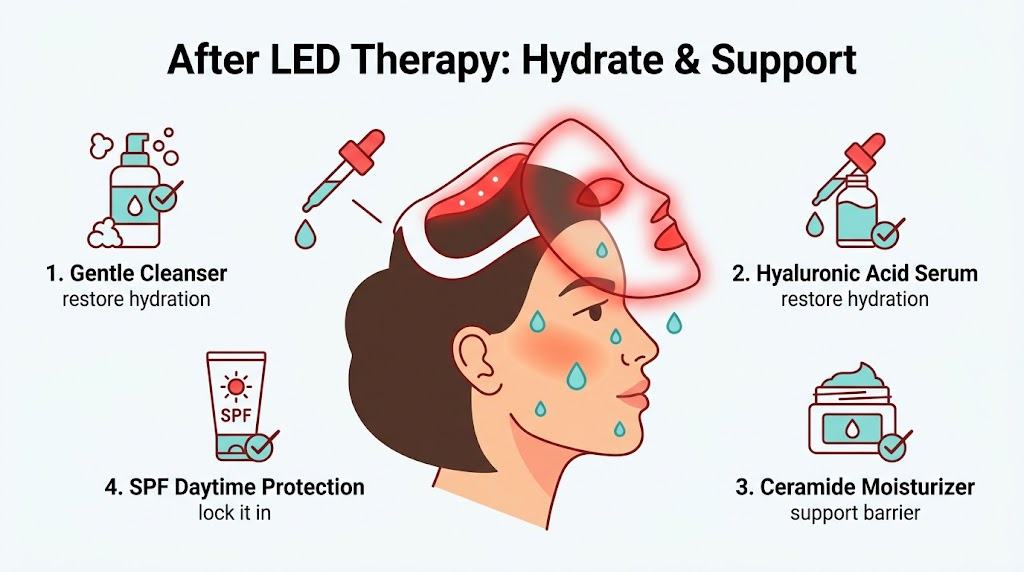
Table of Contents
- 1. How Red Light Therapy Affects Your Skin
- 2. Should You Moisturize After?
- 3. Why Hydration Matters After LED Therapy
- 4. What Kind of Moisturizer Works Best
- 5. What to Avoid Right After
- 6. A Simple Post-Therapy Routine
- 7. Tips for Dryness or Sensitivity
- 8. Choosing Reliable Devices
- 9. Partner With Rainbow Technology
- 10. References
1. How Red Light Therapy Affects Your Skin
Red light therapy uses visible red and near-infrared wavelengths — typically red 630–660 nm and near-infrared 810–850 nm — to interact with the skin. Unlike UV exposure, these wavelengths don’t rely on heat or burning effects. Instead, they support cellular energy production and microcirculation in the treated area[1].
Many users notice that after a session, the skin may feel:
- Slightly warm or more receptive to products
- Temporarily dry or tight
- Calmer in appearance over time with consistent use[2]
Because of these changes, post-treatment skincare focuses on maintaining hydration and supporting the skin barrier[3].
2. Should You Moisturize After Red Light Therapy?
Yes — moisturizing after your session is generally recommended. Applying a gentle moisturizer after treatment can help:
- Restore hydration
- Reduce temporary dryness
- Support the skin’s protective barrier
- Improve overall comfort
However, most device guidelines suggest avoiding heavy products before or during red light therapy, as they may interfere with light exposure. The pattern: clean bare skin before, gentle hydration after. See our pre-treatment prep guide for the “before” half of this equation.
3. Why Hydration Matters After LED Light Therapy
1. Helps Maintain Moisture Balance
Some people experience mild dryness after sessions. A simple moisturizer helps keep the skin feeling comfortable.
2. Supports the Skin Barrier
Ingredients such as ceramides and peptides can help reinforce the outer layer of the skin, especially after repeated treatments[3].
3. Complements Your Skincare Routine
Red light therapy is often used alongside hydrating products rather than replacing traditional skincare steps.
4. What Kind of Moisturizer Works Best
Gentle and Fragrance-Free Options
Look for moisturizers without strong fragrances or high alcohol content to reduce the risk of irritation. Common soothing ingredients include:
- Aloe vera
- Chamomile extract
- Green tea extract
Hydrating Ingredients That Pair Well With LED Therapy
- Hyaluronic acid for lightweight hydration
- Glycerin to attract moisture
- Ceramides to support the skin barrier
These ingredients help maintain balance without feeling heavy on the skin.
Collagen-Supportive Ingredients
Some users incorporate products containing:
- Peptides
- Vitamin C (usually during daytime routines)
Stronger actives, such as retinol, are often introduced cautiously and not immediately after treatment if the skin feels sensitive. For the retinol timing question, see our red light + retinol guide.
5. What to Avoid Right After Red Light Therapy
To keep your skin comfortable, consider avoiding:
- Strong chemical exfoliants (AHAs or BHAs)
- High-strength retinoids immediately after treatment
- Alcohol-heavy or heavily fragranced formulas
Sunscreen is important during daytime routines but is typically applied after your session — not before.
6. A Simple Post-Red Light Therapy Skincare Routine
Here’s a basic routine many users follow:
- Cleanse gently if needed after your session — see our wash-after guide for when washing makes sense.
- Apply a hydrating serum with lightweight ingredients like hyaluronic acid.
- Use a gentle moisturizer to lock in hydration.
- Finish with SPF if you’ll be exposed to daylight.
Keeping the routine simple helps avoid unnecessary irritation.
7. Tips for Managing Dryness or Sensitivity
If your skin feels dry after LED therapy:
- Limit sessions to recommended durations (often 10–20 minutes) — see our session duration guide.
- Stay hydrated throughout the day.
- Use lukewarm water instead of hot showers.
- Consider using a humidifier during colder seasons.
Small adjustments can make a noticeable difference in comfort.
8. Choosing Reliable Red Light Therapy Devices
The experience you have with red light therapy often depends on device quality and consistency of use. When selecting a device, look for:
- Stable wavelength ranges
- Even light distribution
- Built-in timers or safety features
- Comfortable wearable designs
9. Partner With Rainbow Technology
Your moisturizer supports the skin — your device decides what the skin has to work with. At Rainbow, we build multi-wavelength LED devices for consumer and professional markets:
- Wavelength precision: Verified 630–660 nm red, 415 nm blue, and 810–850 nm NIR channels, checked by spectrometer per batch.
- Even light distribution: Consistent LED spacing so every session treats the whole face uniformly.
- Safety built in: Built-in timers, IEC 62471 photobiological safety, CE/RoHS/FCC/KC certificates, ISO 13485 + MDSAP QMS, FDA registration compliance documentation.
- OEM/ODM for global brands: Consult our engineering team; reference designs on our product lineup page.
Request your custom quote today.
10. References
[1] Hamblin MR.
Mechanisms and applications of the anti-inflammatory effects of photobiomodulation. AIMS Biophysics. 2017;4(3):337-361.
[2] Wunsch A, Matuschka K.
A controlled trial to determine the efficacy of red and near-infrared light treatment in patient satisfaction, reduction of fine lines, wrinkles, skin roughness, and intradermal collagen density increase. Photomedicine and Laser Surgery. 2014;32(2):93-100.
[3] Avci P, Gupta A, Sadasivam M, et al.
Low-level laser (light) therapy (LLLT) in skin: stimulating, healing, restoring. Seminars in Cutaneous Medicine and Surgery. 2013;32(1):41-52.

