
Why the Quality of an LED Panel’s Cooling Fan Dictates Product Lifespan
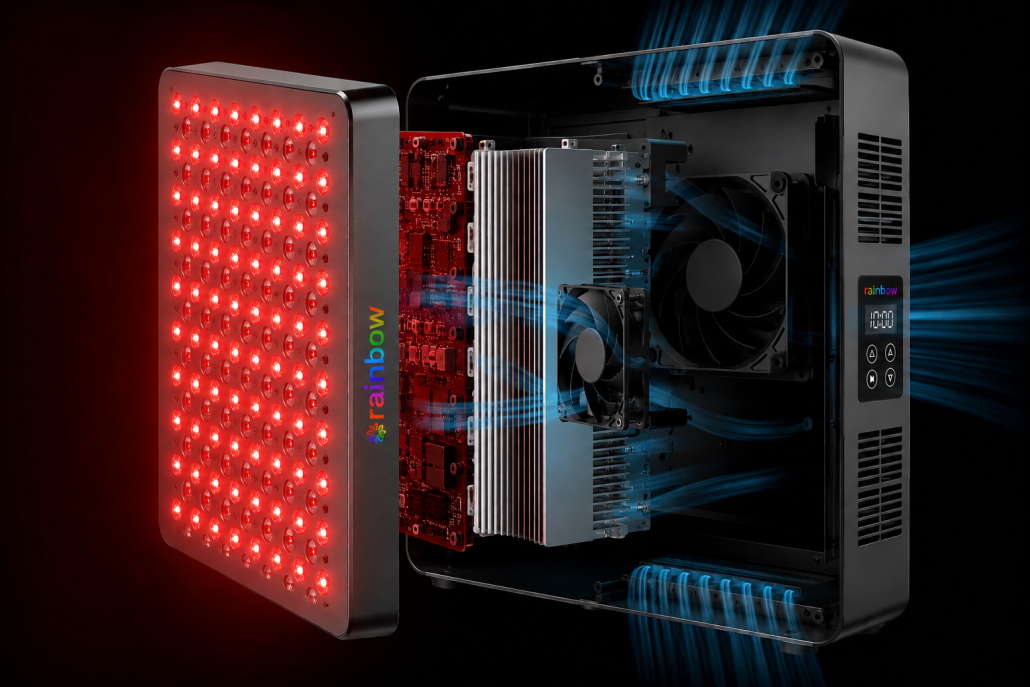
High-power red light panels (a 600W panel dissipates 360-420W of heat) are only 30-45% efficient at turning electricity into light; the rest is heat. And because LED useful life roughly halves for every 10°C rise in junction temperature,[1] a $2-4 cheaper sleeve-bearing fan that fails early can quietly cut an LED panel’s lifespan in half and trigger $250-500 warranty repairs. Industrial-grade ball-bearing fans (MTBF 30,000-60,000 hours, IP54 rated) are the safe choice — and asking a supplier the right five questions exposes which you are actually getting.

Table of Contents
- 1. The Underestimated “Supporting Actor”: A Cooling Fan is Not an Accessory, It’s a Lifeline
- 2. Where Does the Heat in an LED Panel Come From?
- 3. What Exactly Does a Cooling Fan Do in an LED Panel?
- 4. 5 Hard Metrics of Fan Quality (A Factory’s Perspective)
- 5. The True Cost of Inferior Fans
- 6. 5 Questions to Ask About Cooling Fans When Sourcing
- 7. Why Choose an LED Panel Supplier Backed by Factory Testing Data?
- 8. FAQ: LED Panel Cooling Fans
- 9. Partner With Rainbow Technology for Custom LED Devices
- 10. References & External Links
1. The Underestimated “Supporting Actor”: A Cooling Fan is Not an Accessory, It’s a Lifeline
When purchasing an LED red light therapy panel, what do you care about most?
Is the power output correct? Are the wavelengths accurate? Is the irradiance high enough? These are the most common questions. However, there is one critical component that the vast majority of buyers never ask about — yet it happens to dictate exactly how much of that photobiotherapy effect will remain five years down the road.
That component is the cooling fan.
It is no exaggeration to say that for a high-power red light therapy device (600W or 300W panels, or even targeted pads), if the cooling fan quality isn’t up to par, the actual working lifespan of the LED chips could be cut in half or worse. This isn’t just theoretical speculation. In the field of LED systems and factory engineering, premature failures of high-power panels caused by a fan costing less than $4 are far from rare.
The issue is never whether a fan is installed. The problem is that many people treat the cooling fan as a generic spare part anyone can sell, rather than the core actuator of the thermal management system.
In this article, we break things down systematically from an engineering and thermal management perspective: why cooling fan quality directly impacts LED panel lifespan, how massive the differences between fans can be, and how to avoid the most expensive trap when purchasing — which isn’t buying expensive, but buying wrong.
2. Where Does the Heat in an LED Panel Come From? The Physical Boundaries of Thermal Management
To understand why fans are so critical, you first need to understand why LED panels generate heat.
LEDs (Light Emitting Diodes) are inherently not “cold light sources.” Although their luminous efficacy (measured in lm/W) is constantly improving, the electro-optical conversion efficiency of high-power red light chips (630nm-660nm) is typically only 30% to 45%. The remaining 55% to 70% is entirely released as heat.
A nominal 600W full-body red light panel actually dissipates roughly 360W to 420W of heat. If this heat is not removed promptly, the junction temperature (Junction Temperature, $T_j$) of the LED chips will spike rapidly.

The Rule of Thumb for LED Longevity:
For every 10°C rise in LED junction temperature ($T_j$), its lifespan is slashed by approximately 50%.
This conclusion is not just a claim by a single manufacturer. It is derived from the application of the Arrhenius equation to LED aging and is universally cited in the datasheets of major LED chip manufacturers like Philips Lumileds, Cree, and Osram. A panel rated for an L70 lifespan (the time it takes for light output to drop to 70% of its initial value) of 50,000 hours at a junction temperature of 85°C might only last 25,000 hours if run continuously at 95°C. And 95°C is a temperature very easily reached inside a poorly ventilated panel.[1]
Therefore, a cooling fan is not a luxury feature to keep the panel “a bit cooler”; it is a mandatory prerequisite to keep the LEDs operating within their designed lifespan parameters. This is a matter of physics, not personal preference.
3. What Exactly Does a Cooling Fan Do in an LED Panel?
Many people assume a fan just “blows some air.” In reality, a well-designed active cooling system must accomplish three things:
- 1. Dissipate heat from the heat source: Heat travels from the LED chip to the aluminum PCB, then to the finned heatsink, and finally, the fan blows air across the fins to carry the heat away. If any link in this chain fails, heat builds up near the LEDs. The fan handles the final step — transferring heat from the heatsink to the ambient air.
- 2. Maintain an optimized airflow path: The fan’s position, airflow volume, and direction determine how efficiently heat is exhausted. Experienced factories perform CFD (Computational Fluid Dynamics) simulations or physical wind tunnel testing to ensure the airflow covers the entire heatsink assembly rather than creating localized dead zones. A poorly designed airflow path can leave the front half of a heatsink at a normal temperature while the back half overheats — and LED chips are often distributed right in that back half.
- 3. Provide a thermal buffer during load fluctuations: Red light panels are often not run at constant power; some products utilize pulsed power control. During these dynamic changes, the fan must respond rapidly to temperature fluctuations to maintain thermal equilibrium. This requires the fan’s response speed and accuracy to fall within precise engineering tolerances.
Thus, when evaluating a fan’s performance in an LED panel, you cannot simply look at whether it spins; you must look at its comprehensive capability across these three dimensions.
4. 5 Hard Metrics of Fan Quality (A Factory’s Perspective)
When purchasing LED panels, if you only look at whether the fan “spins” and how “noisy” it is, you are flying blind in the most crucial area. The following five metrics are the true benchmarks that separate high-quality fans from the rest:
1. Bearing Type: Ball Bearings vs. Sleeve Bearings
This is the most critical component affecting fan lifespan.
- Ball Bearings: Utilizing steel balls rolling between inner and outer rings, these feature an incredibly low friction coefficient, an extended lifespan, and superior resistance to high temperatures and high speeds. Their MTBF (Mean Time Between Failures) is typically 30,000 to 60,000 hours (approx. 3.5 to 7 years of continuous operation). The downsides are higher cost and noise levels that may not be the absolute lowest at low RPMs.
- Sleeve Bearings (Sliding Bearings): These rely on capillary action to keep lubricating oil between the shaft and the sleeve. While low cost and smooth-running initially, the oil’s viscosity changes drastically with temperature and time. In high-temperature environments (>40°C), the lubrication degrades significantly. Their MTBF is typically only 15,000 to 25,000 hours, and actual lifespan degrades rapidly in hot scenarios.
Factory Insight: The Bearing Trap
Sleeve bearing fans deliver beautiful test data in ambient-temperature laboratories. However, once installed in high-power red light panels and operated in summer indoor environments exceeding 30°C, their actual failure rates spike dramatically.
2. Motor Windings: Copper Wire vs. Aluminum Wire
The conductor material of the fan motor’s windings directly impacts efficiency, heat generation, and lifespan.
- Pure Copper Windings boast high conductivity and low resistance. They generate minimal heat of their own during operation, granting the motor a longer service life.
- Aluminum Windings have higher resistance and a greater temperature rise when energized. Long-term operation accelerates the aging of the winding’s insulation layer, shortening motor life. While aluminum-wire fans are typically 20% to 30% cheaper than copper-wire alternatives, their total cost of ownership ends up higher when factoring in motor lifespans and maintenance costs.
3. Blade Material: PA66 Fiberglass vs. Standard ABS
Fan blades must withstand continuous centrifugal force, airflow impact, and thermal cycling at high speeds.
- PA66 (Nylon 66) + Fiberglass: Offers high mechanical strength, a high heat deflection temperature (>250°C), and excellent anti-aging properties. It resists deformation and cracking over long-term use and is the standard configuration for high-end cooling fans.
- Standard ABS or Recycled Plastic: Low cost, but prone to becoming brittle and deforming under continuous thermal cycling. Some low-cost fans use recycled materials, leading to inconsistent batch quality where blade strength can vary wildly within the same production run.
4. IP Protection Rating: Dust and Moisture Resistance
Red light panels are deployed in diverse environments: homes, beauty salons, physical therapy studios, and gyms. Dust and moisture levels vary heavily across these settings.
Fans without an IP rating allow dust to infiltrate the bearings in dusty environments (especially gyms or spaces undergoing renovation), accelerating wear. In humid environments (near bathrooms or during humid seasons), the lubricating oil in sleeve bearings absorbs moisture, accelerating oxidation. For high-power devices like red light panels that may run continuously for 30-60 minutes per session, fans with an IP54 rating or higher are highly recommended.
5. Speed Degradation Curve
This is the most frequently overlooked metric.
A new fan may be rated at 3,000 RPM, but as bearings wear and lubricants age, its actual speed might drop to 2,500 RPM or even 2,000 RPM after just three months. Airflow volume is roughly proportional to RPM; this means cooling capacity quietly degrades without the end-user ever realizing it — until the LED panel shows signs of accelerated light decay. Quality-controlled factories conduct fan aging tests to chart this curve.
5. The True Cost of Inferior Fans: The Numbers Are Worse Than You Think
There is a saying in manufacturing: “Save pennies on the fan, lose your entire profit margin on returns.” Let’s look at the quantifiable impact:
| Metric | Low-End Sleeve Bearing Fan | Industrial-Grade Ball Bearing Fan |
|---|---|---|
| 24-Month Failure Rate | 15% – 30% (Depending on ambient temp/ventilation) | Under 3% |
| MTBF (At 40°C) | 15,000 – 25,000 Hours | 30,000 – 60,000 Hours |
| Speed Degradation Window | Obvious decay at 6,000 – 10,000 Hours | Maintains >90% speed past 20,000 Hours |

The Cost of a Single RMA (Return Merchandise Authorization)
For a $600 red light panel, a single warranty repair involves:
- International shipping ($80-$150 one way)
- Disassembly and diagnostics ($50-$100 labor)
- New fan + Thermal Interface Material (TIM) ($8-$20)
- Reassembly and testing ($30-$50)
- Return shipping ($80-$150)
Conservatively, the explicit cost of a single fan-related repair runs between $250 and $500, without even accounting for customer churn, brand damage, and communication overhead.
The core issue is clear: choosing a fan that is $2 to $4 cheaper creates a $250 to $500 risk exposure. This is the most classic example of “saving money in the wrong place” in purchasing decisions.
6. 5 Questions to Ask About Cooling Fans When Sourcing LED Panels
Now that you know where the quality differences lie, the next step is asking the right questions during procurement. Here are the five most critical verification questions according to factory engineering departments:
- 1. “What is the exact part number of the fan bearing?” Don’t just ask if it’s a ball bearing — it is too easy to get a casual verbal confirmation. Ask for the specific model (e.g., “Is it a Sunon MF50151VX or ME50151VX?”) or request a datasheet screenshot. Model numbers can be traced; verbal claims cannot.
- 2. “Can you provide the fan’s MTBF data or aging test report?” Legitimate fan manufacturers (Delta, Sunon, Apistek, etc.) provide clear MTBF data (e.g., 50,000 hours @ 40°C). If a supplier says, “We don’t have it, but our quality is great,” that response is an answer in itself.
- 3. “What is the operating temperature range of the fan?” High-temperature environments (>35°C) drastically accelerate sleeve bearing degradation. Confirm the fan’s rated upper operating temperature limit and check if it covers the environment of your target market.
- 4. “What is the IP protection rating of the fan?” Demand a clear specification rather than an evasive “It should be enough.” IP54 is the minimum recommendation for panels used in moderately dusty or humid environments.
- 5. “Where is the thermal test report for the complete panel assembly?” The ultimate validation of a fan is how the whole machine handles heat. Ask the supplier if they have conducted full-power, continuous-run thermal testing, what the measured LED junction temperature ($T_j$) data is, and how much margin remains before reaching the maximum specification limit of the LED (typically $T_{j,\max} = 110^\circ\text{C} – 125^\circ\text{C}$). A larger thermal margin indicates a more reliable, conservatively engineered cooling design.
7. Why Choose an LED Panel Supplier Backed by Factory Testing Data?
Fan quality serves as a proxy metric for a supplier’s overall commitment to product integrity. A manufacturer willing to use industrial-grade ball bearings, provide component traceability, offer MTBF data, and execute system-level thermal testing is a manufacturer that genuinely manages long-term reliability rather than hunting for cheap corners to cut.
This engineering mindset is typically reflected in their certification portfolio. For instance, factories like RainbowDO hold certifications such as ISO 13485[2] (Medical Devices Quality Management Systems), MDSAP[3], and FDA 510(k)[4]. A core requirement of these frameworks is strict traceability and verification records for critical components that impact product safety and performance. Under this structure, a fan is never treated as a mere “accessory” — it is a strictly controlled component.
8. FAQ: Frequently Asked Questions About LED Panel Cooling Fans
Q1: What is the normal range for fan noise?
For home-use red light panels typically operated in living rooms or bedrooms, under 40dB is a comfortable threshold (equivalent to a quiet library). For commercial beauty salons or gyms, noise tolerances can relax up to 50dB. Note that noise is directly proportional to fan speed; lower noise often means lower RPM and lower airflow. Balance your noise requirements against actual thermal demands rather than chasing low-decibel specs in a vacuum.
Q2: If a fan fails, can I replace it myself?
Technically yes, but it is not recommended. Replacing an internal fan requires opening the rear casing, reapplying Thermal Interface Material (TIM), and restoring the airtight structure. If done incorrectly (uneven TIM application, inconsistent screw torque), the cooling performance of the new fan may end up worse than the original. If under warranty, always let the supplier handle it. For DIY repairs out of warranty, ensure you use a fan with the exact same specifications and model number.
Q3: Are fanless, passively cooled LED panels more reliable?
This is a classic debate. Passive cooling (relying solely on an aluminum PCB and a heatsink) eliminates mechanical wear and tear, reducing potential points of failure in theory. In practice, however, passive cooling has higher thermal resistance. Under high-power, continuous operation, LED junction temperatures run significantly higher than in active cooling setups, which can accelerate LED light decay over time. If your application involves lower power and short sessions (<20 minutes), passive cooling is highly viable. For high-power, high-frequency usage, active cooling (fans) remains the safer, more reliable engineering choice.
Q4: How often do cooling fans typically need to be replaced?
It depends entirely on fan quality and usage. Taking an industrial-grade ball bearing fan as an example: under typical residential usage guidelines (30-60 minutes per day), the expected effective lifespan is roughly 5 to 8 years. Beyond this point, preventive checks are recommended (listening for abnormal noises or checking for a noticeable drop in airflow). Sleeve bearing fans under identical usage typically offer an effective lifespan of around 2 to 4 years, which narrows further in hot or dusty settings.
Q5: What fans are used in RainbowDO products?
The entire lineup of RainbowDO red light panels (including the RB-008 vertical panel series, RB-027 wraps, and RB-036 targeted pads) exclusively utilizes industrial-grade ball bearing fans with a default IP54 protection rating. Our engineering team conducts rigorous system-level thermal testing before finalizing any product design to ensure that the LED junction temperature maintains a safety margin of $\ge 15^\circ\text{C}$ below its maximum operating limit. Detailed fan specifications and testing data are readily available to clients during the product development phase.
This article was authored by the RainbowDO Engineering Team based on LED thermal management industry consensus and empirical factory testing data. For specific product selection and sourcing inquiries, please contact: layla@rainbowdo.com / WhatsApp: +86 135 9032 9742
The fan is only one of the components whose quality quietly decides an LED panel’s real lifespan. For the deeper dive into why cooling-fan quality dictates product lifespan — and how to read the specs that matter — see our
Why the Quality of an LED Panel’s Cooling Fan Dictates Product Lifespan.
9. Partner With Rainbow Technology for Custom LED Devices
A $4 fan that fails is the kind of defect no inspection catches after the fact — but a conservative thermal design prevents it before the product ships. This is what we build into every panel:
- Industrial-grade ball-bearing fans only (MTBF 30,000-60,000 hours), never sleeve bearings, on every high-power panel, with a default IP54 protection rating.
- System-level thermal testing on the complete panel assembly — measured LED junction temperature and a documented safety margin, not just component datasheets.[1]
- Component traceability and verification records for every fan and critical part, under an ISO 13485 and MDSAP-aligned quality system.[2][3]
- CFD airflow simulation or wind-tunnel validation so no part of the heatsink becomes a silent hot zone.
- An engineering partner who answers your five sourcing questions with model numbers and test reports — not evasive reassurances.
10. References & External Links
[1] DesignLights Consortium (DLC).
The L70 lumen-maintenance thresholds (light output falling to 70% of initial) and the LM-80 / LM-84 / TM-21 test and projection methods behind LED useful-life ratings — the basis for the “lifespan halves per 10°C of junction temperature” rule cited in this article.
[2] ISO 13485:2016 — Medical devices: Quality management systems.
The framework that makes a fan a strictly controlled, traceable component rather than a generic spare part — cited here for the supplier-certification claim in the article.
[3] FDA — Medical Device Single Audit Program (MDSAP).
The single-audit program that substitutes for routine FDA inspections and signals a manufacturer’s commitment to verified, audited quality records (here, the supplier-certification claim).
[4] FDA — Premarket Notification 510(k).
The substantial-equivalence pathway for medical devices, cited as one of the certifications that backs a supplier’s long-term reliability claims in this article.
