How Close Does Red Light Need to Be to Work? A Comprehensive Guide to Optimal Distance for Red Light Therapy
There is no single “right distance” — it depends on your device class. Wearable masks work at 0–2 cm (skin contact); handheld wands at 0–5 cm; freestanding panels are designed for 10–30 cm (4–12 inches). What actually matters is the dose reaching tissue — irradiance × time — and the biphasic dose-response curve: too little does nothing, too much can inhibit[3]. Follow the distance your device’s datasheet specifies at the working distance it was engineered for — generic “4–12 inches” advice applied to a face mask would be wrong.
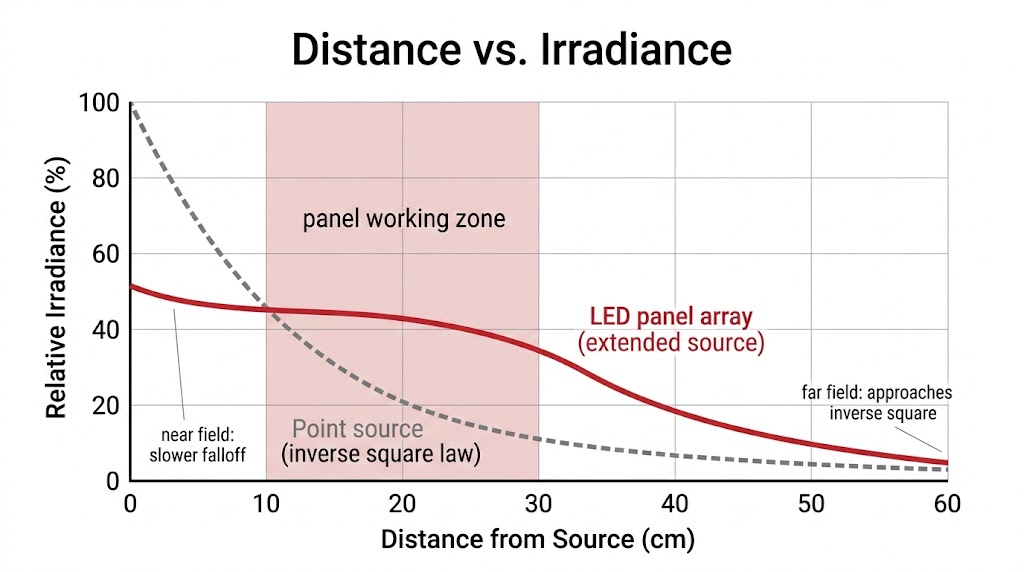
Table of Contents
- 1. Why Distance Matters: The Physics
- 2. Distance by Device Type (The Answer Depends on Your Device)
- 3. The Dose Formula: Irradiance × Time
- 4. Other Factors That Change the Answer
- 5. Practical Tips for Safe, Effective Sessions
- 6. Partner With Rainbow Technology
- 7. References
1. Why Distance Matters: The Physics
The distance between your skin and the device determines the irradiance (light power per area, mW/cm²) reaching your tissue. Two physical realities matter here:
- The inverse square law (for point sources): intensity falls with the square of distance — double the distance, quarter the intensity. But this strictly applies to a point source like a single bulb or laser diode.
- LED arrays are extended sources: a panel or mask is a grid of many emitters. In the near field, their beams overlap, so irradiance falls off much more slowly than the inverse-square curve. This is why a well-engineered panel can still deliver a therapeutic dose at 10–30 cm, and why a mask works at skin contact[2].
Too close and you risk overheating and thermal stress; too far and the dose drops below the therapeutic threshold. The balance is device-specific — which is why generic distance advice fails. See our explainer on PBM dose-response for why “more power” isn’t the goal.
2. Distance by Device Type
The honest answer to “how close does red light need to be?” is: as close as your device was engineered for. Here’s the breakdown by device class:
| Device Type | Working Distance | Typical Irradiance | Best For |
|---|---|---|---|
| Wearable LED mask | 0–2 cm (skin contact) | 20–60 mW/cm² at face | Face-focused skincare: collagen, wrinkles, acne |
| Handheld wand / spot device | 0–5 cm | Varies widely | Localized spots, joints, small areas |
| Freestanding LED panel | 10–30 cm (4–12 in) | ~50–200 mW/cm² at working distance (per datasheet) | Full body, back, muscles, joints, recovery |
Notice what’s missing: a “one size fits all” number. The widely-quoted “4–12 inches” is a panel recommendation — applying it to a face mask (which should touch your skin) would reduce the dose below therapeutic levels. Device type first, then the datasheet. Our mask vs panel guide covers choosing the right class for your goals.
3. The Dose Formula: Irradiance × Time
Distance and duration are two sides of one equation. The dose delivered to tissue is simply:
Worked example: a panel delivers 50 mW/cm² at 20 cm. A 10-minute (600 s) session gives 50 × 600 ÷ 1000 = 30 J/cm². The same panel at 30 cm might deliver ~25 mW/cm² — so you’d need 20 minutes for the same 30 J/cm². This is why a fixed “minutes table” without your device’s irradiance spec is unreliable — and why “irradiance inflation” in spec sheets is a real trap when comparing products[1]. Read our explainer on irradiance inflation before trusting a big number.
And remember the biphasic dose-response: photobiomodulation follows a bell curve — too low a dose does nothing, and pushing far past the therapeutic window can become inhibitory rather than helpful[3]. For skin treatments, most protocols target roughly 3–15 J/cm²; for deeper muscle and joint work with near-infrared, higher doses (and often closer positioning) are used. Our session duration guide has the full breakdown.
4. Other Factors That Change the Answer
- Beam angle: Narrower angles (25°–35°) concentrate light, letting panels deliver therapeutic irradiance at comfortable distances. Wider angles cover more area but dilute power — one reason the “coverage” story needs the irradiance story alongside it.
- Skin type and sensitivity: Sensitive or thinner skin may need slightly greater distance or shorter sessions. Start conservative, observe, adjust.
- Wavelength: Red (630–660 nm) is absorbed in the dermis; near-infrared (810–850 nm) penetrates deeper. NIR protocols for muscles/joints often use closer positioning to push dose deeper.
- Manufacturer guidelines: The datasheet’s working distance is the number that matters most — it’s measured at the factory for that specific LED layout. If a spec sheet doesn’t state the distance at which irradiance was measured, treat the number with suspicion[2].
5. Practical Tips for Safe, Effective Sessions
- Start at the datasheet distance: For masks, that’s skin contact; for panels, the spec’d working distance (often ~15–20 cm). Adjust only from there.
- Compute, don’t guess: Use the dose formula with your device’s irradiance at your chosen distance. Increase session length, not proximity, to raise dose.
- Monitor skin response: Persistent redness or discomfort means back off — increase distance or shorten the session.
- Protect your eyes: For facial treatments with high-irradiance NIR, follow the manufacturer’s eye-protection guidance. See our goggles guide.
- Stay consistent: 3–7 sessions per week at the right dose beats occasional marathons. Consistency is the strongest predictor of results.
- Keep the device clean: Dust on lenses or silicone scatters light and cuts delivered dose.
6. Partner With Rainbow Technology
The distance question is really a spec sheet honesty question — and that’s decided at the factory. When you source from Rainbow:
- Irradiance measured at the actual working distance for each device class — mask (contact), wand (0–5 cm), panel (10–30 cm) — and verified by spectrometer per batch.
- Wavelength-matched LED arrays engineered so the dose at the recommended distance lands in the therapeutic window[3].
- Full CE, RoHS, FCC, KC certificates, ISO 13485 + MDSAP certified QMS, and FDA registration compliance documentation.
- OEM/ODM from concept to certification. Consult our engineering team; reference designs on our product lineup page.
Request your custom quote today.
7. References
[1] Hamblin MR.
Mechanisms and applications of the anti-inflammatory effects of photobiomodulation. AIMS Biophysics. 2017;4(3):337-361.
[2] Jagdeo J, Austin E, Mamalis A, et al.
Light-emitting diodes in dermatology: a systematic review of randomized controlled trials. Lasers in Surgery and Medicine. 2018;50(6):613-628.
[3] Huang YY, Sharma SK, Carroll J, Hamblin MR.
Biphasic dose response in low level light therapy — an update. Dose-Response. 2011;9(4):602-618.
[4] ICNIRP.
ICNIRP guidelines on limits of exposure to incoherent visible and infrared radiation. Health Physics. 2013;105(1):74-96.

