
Does Red Light Tighten Skin? Exploring the Science and Benefits of Red Light Therapy
Yes — red light therapy tightens skin, with an important qualifier: it works through progressive collagen and elastin remodeling, not instant lifting. A 136-subject randomized trial measured increased intradermal collagen density and reduced wrinkle depth and roughness with consistent 611–650 nm sessions[1]; a 660 nm study measured a 31% increase in type I procollagen[2]. Expect visible firmness and elasticity gains over 8–12 weeks of consistent use (2–4 sessions/week). If you’re hoping for an instant “lift” effect like a surgical or radiofrequency treatment, red light isn’t that — and any device claiming otherwise is overpromising.
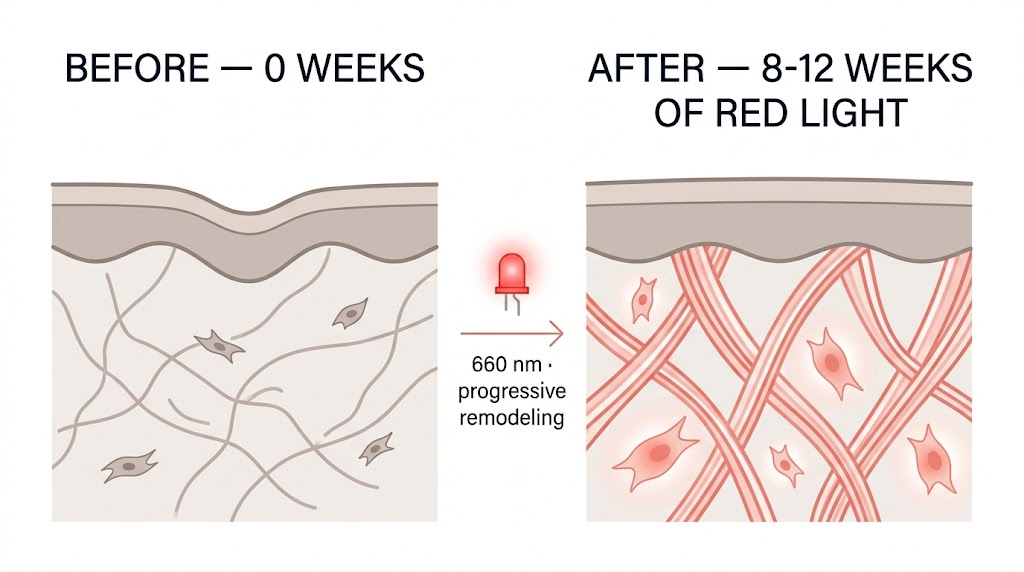
Table of Contents
- 1. What Is Red Light Therapy?
- 2. How Does Red Light Tighten Skin?
- 3. What the Evidence Shows
- 4. Realistic Expectations: Tightening vs. Lifting
- 5. How to Maximize Results
- 6. Partner With Rainbow Technology
- 7. References
1. What Is Red Light Therapy?
Red light therapy (RLT) uses low-level wavelengths of red or near-infrared light, typically 630–660 nm (and 810–850 nm for deeper NIR), to penetrate into the skin’s dermal layer. Unlike UV rays, this light is safe and non-invasive: it carries no ionizing energy, so it stimulates cellular processes without damaging skin[4]. It’s the same mechanism used in clinical photobiomodulation, delivered in a home-use format.
2. How Does Red Light Tighten Skin?
The primary mechanism behind red light’s skin-tightening effect is its ability to stimulate collagen and elastin production. Here’s how it works:
- Boosts cellular energy: Red light is absorbed by mitochondrial cytochrome c oxidase, increasing ATP production — the fuel for cellular repair and regeneration[4].
- Stimulates collagen and elastin: By activating dermal fibroblasts, red light encourages synthesis of collagen and elastin — the proteins responsible for skin’s firmness and elasticity. Measured effects include a 31% increase in type I procollagen and an 18% reduction in the collagen-degrading enzyme MMP-1[2].
- Enhances blood flow: Improved circulation delivers essential nutrients and oxygen to the skin, supporting healing and a radiant complexion.
- Reduces inflammation: Photobiomodulation modulates inflammatory signaling, helping decrease puffiness and irritation — a calmer skin surface reads as firmer and more toned[4].
3. What the Evidence Shows
| Outcome | Evidence Level | What the Trials Show |
|---|---|---|
| Firmness via collagen density | ✅ Strong | 136-subject RCT: intradermal collagen density increased with twice-weekly 611–650 nm light over 30 sessions, maintained at 12-week follow-up[1]. |
| Fine lines & wrinkles | ✅ Strong | Significant wrinkle depth and roughness reduction in the same RCT; corroborated by a 31% procollagen I increase in the 660 nm study[1][2]. |
| Elasticity & bounce-back | ✅ Good | Supported by the systematic review of 31 LED RCTs reporting consistent skin appearance improvements[3]. |
| Hyaluronic acid / hydration | ⚠️ Emerging | Some research points to photobiomodulation supporting hyaluronic-acid-related pathways, but this is early-stage evidence — treat as a bonus, not the headline. |
| Instant “lift” (RF/surgery-like) | ❌ Not the claim | Red light does not mechanically tighten or lift tissue. Anyone promising immediate tightening is selling you something else. |
4. Realistic Expectations: Tightening vs. Lifting
The honest answer to “does red light tighten skin?” is: yes for firmness, elasticity, and texture — through collagen remodeling over 8–12 weeks. The mechanism is biological, not mechanical. Red light rebuilds the scaffolding that makes skin look firmer; it doesn’t physically pull or lift tissue the way radiofrequency, ultrasound, or surgery do.
That distinction matters: it’s why results are cumulative and require consistency — and why a device’s irradiance decides whether the light actually reaches the dermis. A mask with insufficient power density may glow beautifully and do almost nothing. See our buyer’s checklist for the specs that separate a clinical tool from a beauty toy.
5. How to Maximize Results
- Consistency is key: Aim for 2–4 sessions per week over 8–12 weeks[1]. Collagen remodeling is cumulative — sporadic use is the #1 reason results disappoint.
- Use the right dose: Session length depends on your device’s irradiance. See our session duration guide for the full breakdown.
- Hydrate and protect: Drink plenty of water and apply sunscreen daily — collagen you build shouldn’t be UV-degraded.
- Combine with skincare: Pair with retinol or hyaluronic-acid serums for complementary effects — see our red light + retinol guide for the routine.
6. Partner With Rainbow Technology
By stimulating your skin’s natural repair mechanisms, red light therapy offers a safe, evidence-backed path to firmer, younger-looking skin — when the device is built to deliver. That’s where Rainbow comes in:
- Clinical-grade irradiance and verified 630–660 nm wavelengths, checked by spectrometer on every batch.
- Full ISO 13485, CE, and FDA registration compliance documentation.
- OEM/ODM from concept to certification — low MOQs for brand launches. Consult our engineering team.
- Reference designs on our product lineup page.
Request your custom quote today.
7. References
[1] Wunsch A, Matuschka K.
A controlled trial to determine the efficacy of red and near-infrared light treatment in patient satisfaction, reduction of fine lines, wrinkles, skin roughness, and intradermal collagen density increase. Photomedicine and Laser Surgery. 2014;32(2):93-100.
[2] Barolet D, Roberge CJ, Auger FA, et al.
Regulation of skin collagen metabolism in vitro using a pulsed 660 nm LED light source: clinical correlation with a single-blinded study. Journal of Investigative Dermatology. 2009;129(12):2751-2759.
[3] Jagdeo J, Austin E, Mamalis A, et al.
Light-emitting diodes in dermatology: a systematic review of randomized controlled trials. Lasers in Surgery and Medicine. 2018;50(6):613-628.
[4] Hamblin MR.
Mechanisms and applications of the anti-inflammatory effects of photobiomodulation. AIMS Biophysics. 2017;4(3):337-361.

